
Save Energy and Money – Insulate Your Crawl Space Properly

Our home was built in 1941 with no basement, just a crawl space. Being a first-time homeowner, and being the neighbor of frugal people, I learned something valuable this past week:
Insulate your crawl space to block drafts and energy loss.
Since buying the house 2 years ago, we’ve noticed drafts coming from certain parts of the home, but we’ve focused on trying to block the air from within the home itself. However, the true problem was our crawl space vents. If you do not have a basement, you probably have noticed vents all around your home leading into the crawl space.
These vents have a single purpose: To allow humidity to escape from under your home.
Why would you need to vent the humidity under your home? Where does it even come from? Well, thanks for asking! Let me answer those questions for you!
Where does the humidity come from?
Unless you live in the Sahara, and never get a monsoon season, you need to worry about the water stored in the ground. On any spring, summer, or fall day, place an empty can, with both ends removed, on the ground. Cover that can with plastic securely. On a hot day, you’ll soon notice condensation forming on the underside of the plastic. It may take longer on a cooler day, but it’ll form. What does this tell you?
It tells you that the ground is always releasing water into the air. There’s physics or something behind it, and I’m sure there’s saturation levels involved, but rest-assured that this affects your crawl space. This leads us to our next question…
How does this affect me?
If you own a crawl space, and it is not properly vented, the moisture from the ground will go directly into your insulation and floorboards. Mold will form and your flooring will begin to rot. I don’t mean to scare you, but I hope you get the point that this moisture NEEDS TO GET OUT! (or at least be contained…read on)
What can I do to my crawl space?
Well, this answer comes in two parts.
First, make sure your vents are open in warm months. Oh, and make sure you have vents. We found that in our home the vents had metal flashing that was partially closed even in the summer months. For now, we kept them closed, and even insulated them, but I’ll get to that later.
In your case, make sure your vents are covered with mesh to prevent small intruders, and ensure there is proper flow on both the inside as well as the outside of the vent (i.e. make sure nothing is blocking either side).
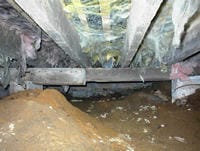
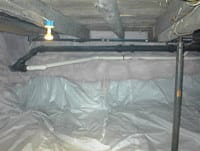
Second, make sure your dirt is covered with heavy plastic. When we re-insulated our crawl space a few years ago, we laid down a good plastic covering, but not enough (we needed a break from the confined space). We need to add more, and that will happen this spring.
The images below illustrate the before and after of a properly covered crawl space. Note, though, that the ceiling is not yet insulated:
And now the last question:
But what about all that cold air in the winter???
Good question. There are vents that automatically close depending on the temperature (non-electric and electric). However, their seals may not be the tightest, and if these vents are on the windy side of your home, you may still feel a draft.
In our case, we decided to stuff R-13 insulation into plastic garbage bags, then into each vent. We noticed an IMMEDIATE and CONSIDERABLE change in temperature and draftiness (or lack of) inside our home. Nick did the same, and now notices his hardwood floors are not nearly as cold anymore.
However, we must make sure we remove the insulation before the beginning of spring so we can vent out the humidity from the crawl space.
If you have proper plastic covering on your crawl space floor, you can tend to wait longer to remove any covering or insulation from your crawl space, but it’s always good to protect yourself on all fronts.
Summary
- Make sure your crawl space is vented and the vents are not blocked
- Cover your crawl space floor with heavy plastic sheeting
…all the way up the foundation walls. You’ll need to get the big stuff, something like 10 x 25. It needs to be heavy duty so it won’t break down. For example check this roll on Amazon
- Close or insulate the vents in the winter to save heating costs and you and your family from cold tootsies
- Remember to remove or unblock the vents before the temperature begins to stay above freezing for extended periods
- Be careful when working with fiberglass insulation. Wear goggles, a mask, and thick plastic or rubber gloves. Also, cover all exposed skin when working with it in your crawl space. Those little particles can lodge in your lungs and skin, and be very hard to remove
 …all the way up the foundation walls. You’ll need to get the big stuff, something like 10 x 25. It needs to be heavy duty so it won’t break down. For example
 Photo Credit: Krystle.
Related Posts
-

Costco is well known for its great prices, and their liquor store is no different.…
-
A relatively inexpensive way to make a room look new again is to paint the…
-
It's a parent's responsibility to teach their children about finances. As kids get older, they…
-

Taking your car to the shop is already stressful, but it gets even trickier when…
-

The average U.S. household mortgage debt equates to $189,586. So if you're like most American…
-

December is a month of twinkling lights, cozy evenings, and, if you’re willing, relationship magic.…

I have an addition to my house that has a crawl space under it. It is open to my basement by the way of the old basement windows. The floor above the crawl space is cold how should I go about insulating the area of the crawl space. Insulating the floor joist or by fully encapsulating.
Greetings….
I have a crawl space. So if I understand. The vents that are located on the foundation wall, i believe one in the front. If there is another one it is in the back of the house under the deck.
I need to close that vent, and it will kill the draft I am getting in the cold months?
I am also wondering is there a product that I could lay down on my sub-floor. We are about to replace our carpet in the drafty rooms. It is time for it to go. So we are going to get a carpet pad with an insulation value of 2.1. The cost is real good as well, so we are going to go for it. While the existing carpet is up, I am going to screw down some loose spots on the sub-floor. I would like to know is there a product that I can use as a membrane to either roll on or spay on the existing plywood sub-floor. It might be some type of rubber based product. I want to use something that will protect in the winter, and in the summer not smell up the place. And has a high temperature point to it.
Any information would be great
Thanks
I bought a 1952 home with a crawl space and the vents on one side are sealed with dirt. Do I need to open these? I live in an area that is cold in winter (fear of broken pipes) and hot in summer. I was told to place a vapor barrier on the ground, but they said nothing about removing the dirt. My contractor has removed it (dirt), but I DON’T think it is correct. HELP! The brick that keeps water from getting in this space has been removed (is water going to run under the house?).
I put a temp/humidity digital probe down in my crawl to see what was going on. You can find them cheap on the net. The temp stayed about 58 (Maine) in the winter and the humidity was well over 75%. The house was drafty and some of my shoes mildewed in my closet. I has the crawl professionally sealed and installed an air conditioner unit (dehumidifier). The temp stays the same but the humidity is a pretty much a constant 40%. The crawl has a pea stone floor which was covered. I tried laying 8 mil plastic over it some time ago but it didn’t keep the moisture down. The moisture is the killer. Nothing can grown under 50% humidity. Heck, I can store anything down there now, it looks and feels like a giant clean room.
First off I want to say great blog! I had a quick question which I’d like to ask
if you don’t mind. I was curious to find out how you center yourself and clear your head prior to
writing. I have had a difficult time clearing my thoughts in getting
my thoughts out. I do enjoy writing but it just seems like the first 10 to 15 minutes tend to be
wasted simply just trying to figure out how to
begin. Any recommendations or tips? Kudos!
Insulating the floor in your home will definitely make you more comfortable. Once you repay yourself in energy savings for the cost of installing the insulation,you’ll really start to save money on your fuel bills.
When I moved into my small home, I found out that the house has a crawl space and I was wondering what I can do with this. Thanks for answering. Though the house is well insulated already, it might be better to get it checked.